
English| EUR
Suggested for you
More currencies
Choose a language
Munich's National Socialist past is not gathered in one museum. It sits in pavements, plaques, empty plinths and repurposed ministries across a walkable half-kilometre near Königsplatz. This page explains what a self-directed route actually covers, where it begins, and the timing that makes the difference.
Quick answer
A munich third reich self guided tour is free to begin: entry to the NS-Dokumentationszentrum permanent exhibition costs 0 EUR, and the surrounding sites are open streets. The centre stands at Max-Mannheimer-Platz 1, 80333 Munich, and opens Tuesday to Sunday, 10:00–19:00. It closes on Mondays, the single most common planning error visitors make.
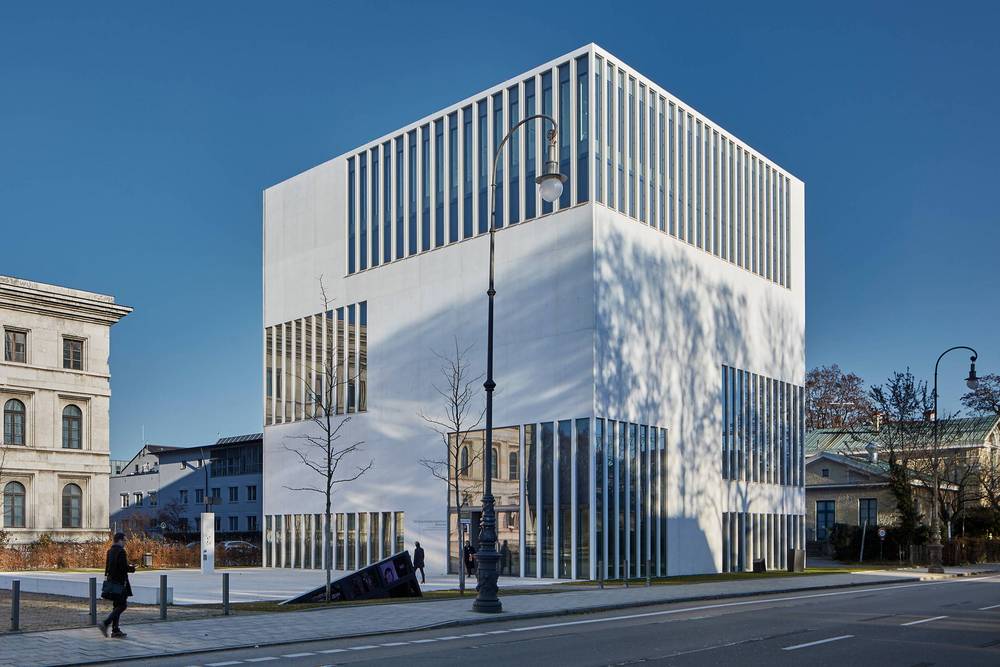
The white cube at Max-Mannheimer-Platz stands on the footprint of the Brown House, the Nazi Party headquarters bought in 1930 and destroyed by Allied bombing. Nothing of the building was rebuilt. That deliberate absence is the organising idea behind every serious munich third reich self guided tour: the city chose documentation over reconstruction, and the walk is largely a walk between things that are no longer there. What the reader is dealing with, then, is a route rather than a monument. Within a few hundred metres of Königsplatz sit the Führerbau, where the Munich Agreement was signed in 1938 and which now houses a music and theatre university; the former Verwaltungsbau, now home to the Central Institute for Art History; and the exposed foundations of the two Ehrentempel, dynamited in 1947 and left as overgrown plinths. Königsplatz itself, paved over in granite for party rallies and returned to lawn in the 1980s, reads as an ordinary park until the context is supplied. Further east, the Feldherrnhalle marks the collapse of the 1923 putsch, and the Viscardigasse alley behind it carries a line of bronze cobbles tracing the detour Munich residents took to avoid saluting. A Munich Nazi-era walking route without a guide depends on knowing these markers exist; most carry no signage that explains them. That is where the documentation centre earns its place at the start rather than the end. Its four floors move chronologically from the party's Munich origins through the machinery of persecution to postwar silence, and the top-floor windows look directly onto the Führerbau and the temple foundations. Reading the exhibition first turns the rest of the walk from sightseeing into recognition. The centre also publishes free digital material and an outdoor information system with roughly a hundred stations across the city, which extends any munich third reich self guided guide well beyond the Maxvorstadt core. The practical consequence is a sequencing decision. Start inside, then walk outward; the exhibition is text-dense and demanding, and few people absorb it after two hours on their feet. Book nothing, but check the centre's own calendar before travelling, since special exhibitions and commemorative closures occasionally shift access. For visitors who want the wider network of Munich landmarks tied to this history — Dachau, the Hofbräuhaus, the Munich Documentation gallery routes — a guided option covers ground a solo walk cannot reach in one day.
“The city chose documentation over reconstruction, and the walk is largely a walk between things that are no longer there.”
This plan suits independent visitors who want a walkable, chronological route through Munich's Nazi-era sites on foot, starting at the NS-Dokumentationszentrum at Max-Mannheimer-Platz 1. Allow roughly five hours in total, including about two hours inside the documentation centre itself.
Arriving in the 10:00–12:00 window gives you a quieter run through the four exhibition floors, which descend chronologically from the top floor down. Budget two hours; the learning forum in the basement is worth ten minutes if you have questions to follow up.
Walk two minutes south to Königsplatz, the parade ground of the Nazi period. The exposed foundations of the two Ehrentempel sit at the eastern edge, overgrown deliberately, and take about 20 minutes to circle with the Glyptothek and Propyläen in view.
Both former party buildings stand on Arcisstraße, one minute from the Ehrentempel and now housing the music university and an art institute. Fifteen minutes is enough to read the exteriors; the 1938 Munich Agreement was signed inside the Führerbau.
Pause for 45 minutes at one of the cafés on Brienner Straße before continuing south. Refill a water bottle here, as the remaining stops are outdoor and shadeless.
Ten minutes on foot down Brienner Straße brings you to the site of the 1923 putsch's final shootout. Allow 20 minutes, and look for the bronze line in Viscardigasse behind it marking the alley people used to dodge the mandatory salute.
Take the S-Bahn one stop east from Marienplatz to Isartor, then walk ten minutes to Rosenheimer Straße. A floor plaque marks Georg Elser's 1939 assassination attempt; 20 minutes covers the site and the nearby Gasteig approach.
If you still have daylight and energy, the S2 from Marienplatz reaches Dachau station in about 25 minutes, plus a 10-minute bus transfer. Treat this as a separate half-day rather than a tail-end stop, since the memorial site needs three hours to do properly.
The NS-Dokumentationszentrum Munich is open daily except for Mondays. Please plan your visit accordingly to accommodate this weekly closure.
The NS-Dokumentationszentrum is located at Max-Mannheimer-Platz 1, 80333 Munich. The most efficient way to reach this site is by utilizing Munich's extensive public transit network.
U3 or U6 to Universität stop
Line 27 to Pinakotheken stop
Line 100 to Max-Mannheimer-Platz stop
To avoid afternoon school groups and peak tourist crowds, plan your arrival for the 10:00–12:00 window.
To experience the sites with fewer crowds, the best arrival window is 10:00–12:00. Arriving early helps you avoid the afternoon influx of school groups and peak tourist traffic.
—
These hours offer the quietest atmosphere for reflection at memorials and exhibitions.
Mild temperatures 10°C to 20°C
Outdoor walking portions are comfortable before the peak summer heat.
Cooler 8°C to 17°C
Visitor numbers decline, providing more space at key historical markers.
Warm 15°C to 24°C
Expect larger crowds and longer waits at major public sites.
Verdict: The optimal time to start is Tuesday to Thursday between 10:00 and 12:00 during the months of April or October.
Munich did not inherit the Nazi movement; it incubated it. In February 1920 Hitler read the 25-point programme of the newly renamed NSDAP to some 2,000 listeners in the Hofbräuhaus banquet hall. Three years later, on 8–9 November 1923, the party attempted to seize Bavaria from the Bürgerbräukeller. The march ended at the Feldherrnhalle on Odeonsplatz, where state police fire killed sixteen putschists and four officers. Hitler served thirteen months at Landsberg and drafted Mein Kampf there. Any munich third reich self guided tour begins with that failure, because the regime later rewrote it as scripture. In 1935 Munich was formally titled Hauptstadt der Bewegung, Capital of the Movement. The Nazi Party bought the Barlow Palace on Brienner Straße in 1930 and reopened it in 1931 as the Brown House, party headquarters. Paul Ludwig Troost then framed Königsplatz in granite slabs and raised two Ehrentempel in 1935 to hold the sixteen dead. On 30 September 1938 Hitler, Chamberlain, Daladier and Mussolini signed the Munich Agreement in the Führerbau, one street away. Dachau, the first permanent concentration camp, had opened 16 kilometres north on 22 March 1933. What survives is deliberately uneven. The Ehrentempel were blown up in January 1947; their plinths remain under ivy. The Führerbau and the Verwaltungsbau stand as a music academy and an archive. The Brown House was bombed out and cleared, and on its footprint the NS-Dokumentationszentrum opened on 30 April 2015 at Max-Mannheimer-Platz 1 — white, windowless toward the square, holding no relics by design. A walking route through munich landmarks of this period, or a munich third reich self guided tour of Königsplatz and Odeonsplatz, ends here, where the bronze plaque marking the Feldherrnhalle dead is now a memorial to those who refused to salute.
Hitler presents the NSDAP's 25-point programme in the Hofbräuhaus festival hall on 24 February.
The Beer Hall Putsch collapses under police fire at the Feldherrnhalle on 9 November.
The party opens its Brown House headquarters in the former Barlow Palace on Brienner Straße.
The Dachau concentration camp opens north of Munich on 22 March.
Munich is formally designated 'Capital of the Movement' and Troost's two Ehrentempel are dedicated on Königsplatz.
The Munich Agreement is signed in the Führerbau on 30 September.
US occupation engineers demolish the Ehrentempel superstructures in January, leaving the plinths.
The NS-Dokumentationszentrum opens on the Brown House site on 30 April, seventy years after the war's end.
Everything you need to know about munich third reich self guided tour
Entry to the permanent exhibition at the NS-Dokumentationszentrum is 0 EUR. This documentation center serves as a key hub for those researching Nazi history independently.
To avoid school groups and peak tourist crowds, the best arrival window is 10:00–12:00. Arriving early ensures a more focused experience when navigating these historical sites.
Yes, many visitors prefer a munich third reich self guided tour to explore significant landmarks at their own pace. You can easily plan your own route between this museum and other historical markers in the city center.
The facility is open Tuesday through Sunday from 10:00–19:00. Please note that it remains closed on Mondays.
While the content is educational and informative, it covers sensitive historical topics. Parents should assess if the intensity of the exhibition is appropriate for younger children before visiting.
The center is located at Max-Mannheimer-Platz 1, 80333 Munich, Germany. This location is centrally accessible for anyone beginning their historical walking route.